Riding a motorcycle across India is unlike touring almost anywhere else on earth. One day you are navigating cow-crossings on a busy market street, the next you're crossing a 5,000-metre Himalayan pass in freezing wind, and the day after that you're sweating through the Thar Desert at 45°C. This range is exactly why India draws international riders back year after year- but it also means you are planning to go beyond "book a bike and go." This guide covers the practical groundwork: what to pack, what gear actually matters, what to carry in case of illness or injury, and how to protect your belongings on the road.
1. What Should You Pack in Your Suitcase?
Before you even think about what to pack, think about what you're packing it in. This is one of the most overlooked parts of trip planning, and it makes a real difference once you're riding for weeks on rough roads.
Skip the hard suitcase. A rigid case doesn't strap onto a motorcycle or pannier rack, doesn't compress when space is tight, and cracks the first time it's dropped on a rocky trail. Instead, go for a soft duffel bag- canvas or heavy-duty fabric, the kind sailors and overlanders have used for decades. It flexes to fit onto a rack, compresses when half-empty, and survives being roped down and bounced around.
A few practical additions that make a real difference:
- A small padlock for your duffel- not for serious security, but enough to deter opportunistic theft at guesthouses and roadside stops.
- A luggage tag with your contact details, useful if bags get separated during flights, train transfers, or group logistics.
- A 10–20 litre daypack for anything you need access to during riding hours- camera, sunscreen, water, snacks, documents- since your main duffel will usually be strapped down and inaccessible mid-ride.
Pack light. Aim to stay under roughly 15–20 kg total. India's roads mean frequent loading and unloading, and every kilo you don't need is a kilo you'll regret carrying up a guesthouse staircase in Leh's thin air. Also check your airline's baggage allowance in advance-many budget and regional carriers within India have stricter limits than international long-haul flights.
Waterproofing matters more than you'd think. Even outside monsoon season, sudden downpours in the hills are common. Pack a few large plastic bags or dry-bags inside your duffel, or use a waterproof liner, so a sudden cloudburst doesn't ruin your clothes and electronics.
This Guide for essential packing lists for motorcycle touring becomes more important if you are opting for Self-Guided Tour instead of Group Tours.
2. How to take care of my Clothing and Personal Items during the trip?
What you wear off the bike matters almost as much as what you wear on it, especially given how much India's climate shifts within a single trip.
Everyday clothing:
- Lightweight trousers for evenings and for visiting temples or mosques, where shorts are often not permitted.
- A mix of t-shirts and a couple of full-sleeve shirts-the long sleeves aren't just for sun protection but also help against mosquitoes in lower-altitude regions like Rajasthan or Kerala.
- A light fleece or jacket, since evenings even in "warm" regions can turn surprisingly cool.
- Comfortable, closed walking shoes for exploring towns and forts, plus a pair of sandals or flip-flops for guesthouses.
- A cap or wide-brim hat, and proper UV-rated sunglasses-sun exposure at altitude and in the desert is intense and easy to underestimate.
- A torch or headlamp-power cuts are common in smaller towns and rural areas, and pitch-dark stretches of highway have little to no lighting.
- A refillable water bottle or hydration pack; you'll go through far more water than expected, particularly in Rajasthan.
Snacks worth packing: energy bars, dried fruit, or biscuits are useful on long, remote stretches such as the Manali–Leh highway or the roads through the Thar Desert, where meal stops can be hours apart.
3. What is the mandatory Riding Gear that You Actually Need?
This is the section international riders most often get wrong-either underpacking because "it's a warm country," or overpacking heavy touring gear that becomes unbearable in 40°C heat. The reality is that a single India trip can demand both extremes, sometimes in the same week.
Non-negotiable safety gear:
- A certified full-face or flip-front helmet with proper eye protection (visor or goggles). Note that helmet standards and enforcement vary by state, so bring a helmet you trust rather than assuming you can rent a good one locally.
- Reinforced motorcycle gloves.
- Riding boots with ankle protection-this matters enormously on loose gravel, river crossings, and unpaved switchbacks common in the Himalayas.
- A riding jacket with back protection (armour or airbag), shoulder and elbow protectors.
- Riding trousers with knee protection.
- A rain suit or waterproof over-layer.
- A neck gaiter or dust scarf-genuinely essential on dusty desert roads and construction-heavy highway stretches.
If you are heading into the Himalayas (Leh-Ladakh, Spiti, Manali-Leh Highway) for Himalayan Motorcycle Tour Experience, temperatures can swing by 20–25°C within a single day, and snow is possible even in what's technically "riding season" (June–September). Pack a season-mixed riding suit with a removable thermal liner, a second pair of gloves (a warm pair and a lighter pair), and a spare pair of socks. Altitude sickness is a real risk above 3,000m-more than below.
If you're going to ride across the Sand Dunes of Rajasthan or other hot-weather regions: prioritise a well-ventilated summer jacket, lightweight summer gloves, and airy riding boots. Heat exhaustion is a bigger practical risk here than cold ever will be, so ventilation matters more than armour thickness.
A quick tip on flights: check with your airline in advance whether you can carry your helmet and airbag vest as cabin baggage rather than checked luggage-many riders prefer to keep this gear with them rather than risk it being damaged or delayed in transit.
4. What are the essential items for a Personal First-Aid Kit?
You don't need to carry a full pharmacy, but a well-thought-out kit saves real trouble in places where the nearest chemist might be hours away.
Recommended basics:
- High-SPF sunscreen (India's UV index, especially at altitude, is stronger than most riders expect).
- Lip balm with SPF- Wind and altitude dry lips out fast.
- Basic pain relief (paracetamol, ibuprofen or aspirin).
- Diamox (acetazolamide) if you're riding above 3,000m- a standard precaution against altitude sickness on Himalayan routes like Khardung La or Umling La. Speak to a doctor before your trip about dosage and whether it's appropriate for you.
- Anti-diarrheal medication and oral rehydration salts- genuinely useful given the change in food and water.
- Plasters, blister pads, and basic bandages.
- Antiseptic/disinfectant for minor cuts and scrapes, which are common with motorcycle travel.
The single best piece of advice here: build your kit with your own doctor, factoring in your medical history and your specific route. A rider heading only through Rajasthan has very different needs from one crossing Himalayan passes above 5,000 metres.
5. How to Protect your Belongings on the Trip?
India motorcycle trips mean changing accommodation almost daily, eating at different places for every meal, and covering a lot of ground with a lot of loading and unloading. That's a lot of opportunities to misplace something.
The most important rule: you are responsible for your own belongings, so travel light on valuables. Avoid carrying anything you'd be devastated to lose-expensive jewellery, high-end camera gear, tablets, or large amounts of cash. If you do carry valuables, never leave them unattended, including inside a support vehicle if you're travelling with an organised tour-vehicles get broken into just like anything else.
A few added practical habits worth building for India specifically:
- Keep photocopies (physical and digital) of your passport, visa, driving licence/International Driving Permit, and travel insurance-separate from the originals.
- Use a small day-pouch or money belt for cash and cards rather than carrying everything in one wallet.
- Carry a mix of cash and cards; many small towns and fuel stations along Himalayan and desert routes are cash-only, and ATMs can be sparse for long stretches.
- A portable power bank is worth its weight-mobile signal and charging points can be unreliable on remote stretches, and you'll want your phone charged for navigation and emergencies.
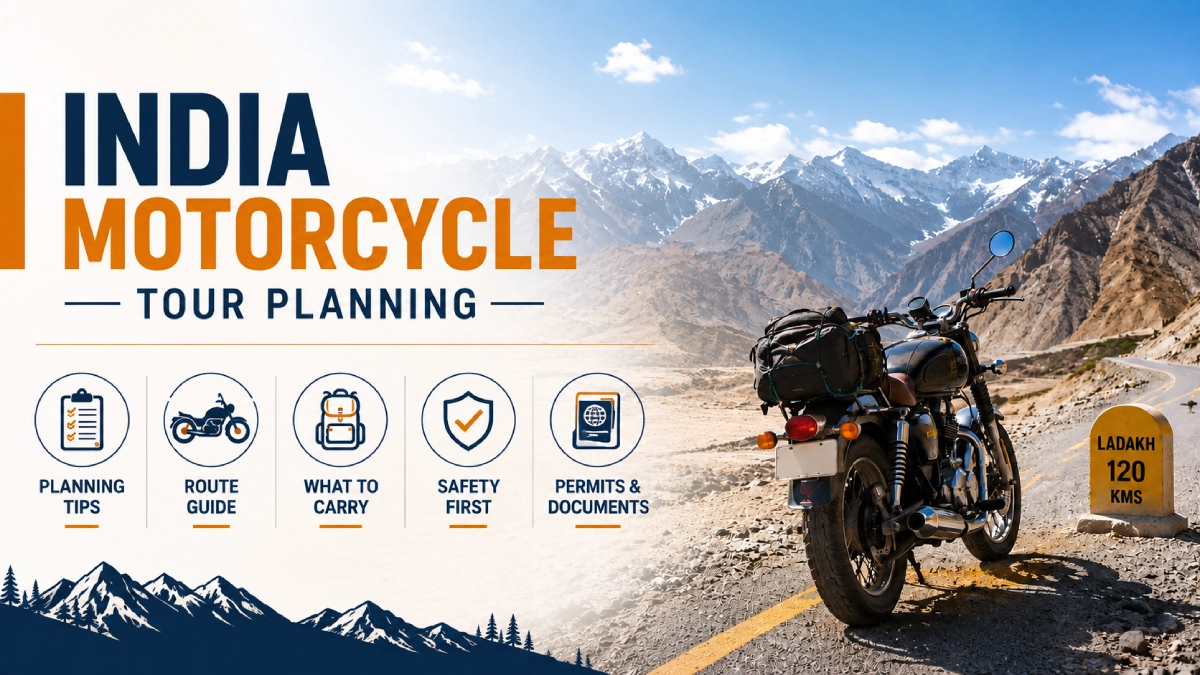
6. What is the procedure of getting a visa, travel insurance and IDP?
This is the part of trip planning that's easy to underestimate, because none of it is visible on the road-until it's missing, and you're stuck at an airline counter or immigration desk. Build this checklist early, ideally as soon as you commit to your trip dates.
Passport: Make sure it's valid for well beyond your trip-most riders aim for at least 6–7 months of validity remaining after your intended entry date, and India's visa system checks this strictly. You'll also need a few blank pages left, and every name that appears anywhere on your passport (maiden names, married names, aliases) needs to match your visa application exactly, since this is cross-checked at boarding and on arrival.
Travel insurance: Don't assume a standard travel policy covers you. Confirm in writing that it covers medical costs and repatriation, and-critically-that it explicitly covers motorcycling and off-road riding. Plenty of standard policies quietly exclude two-wheeler travel, which only becomes obvious after something's gone wrong.
Flight ticket copy: Keep a copy (digital and printed) of your return or onward flight, as it's often requested during visa processing and at immigration.
Visa – the e-Tourist Visa: Most international riders will apply through India's e-Visa system, which is done entirely online-no in-person appointments or original documents to post. You can apply directly via the official Indian government portal, though the process has a reputation for being fiddly, so build in time and double-check every field before submitting. Timing depends on the visa type:
- A 1-year e-visa can be applied for as soon as your flights are booked, provided your departure is within 365 days.
- A 30-day e-visa has a narrow application window-typically only between about three weeks and one month before your arrival, not earlier.
You'll also need to provide contact details for a local address or contact in India to complete the form, so have this ready before you start the application.
e-Arrival Card: Since October 2025, India has replaced the old paper immigration form with a digital e-Arrival Card, which every traveller must complete online within 72 hours before arrival-regardless of whether your e-Visa is already approved. Set a calendar reminder for this, since it's easy to forget in the last-minute rush before a flight, and immigration will ask for it on arrival.
International Driving Permit (IDP): This is mandatory for riding in India. An IDP works as an official translation/validation of your home licence-it does not replace it, so carry both together at all times. Processing times and validity periods vary considerably by country, so apply as early as possible in your planning; leaving it until the final weeks is one of the most common (and avoidable) hold-ups riders run into.
Inner Line Permits (ILPs): Needed for certain restricted border-adjacent zones, particularly in Ladakh. These are generally arranged locally once you're in the region, but processing can slow down in peak season, so build in buffer time rather than assuming a same-day permit.
💡 Practical tip: Keep both physical and digital (cloud or email) copies of every document above-passport, visa approval, IDP, insurance policy, and flight tickets-stored separately from the originals. If something is lost or stolen mid-trip, having backups turns a major disruption into a minor inconvenience.
7. What Budget Should You Plan For?
Even if you have booked Guided India Motorcycle Tour Packages that include your accommodation, bike rental, and main logistics, you'll still need pocket money for the day-to-day extras-meals not included on rest days, drinks, souvenirs, entry tickets for monuments and museums, and tips for local guides or support crew. As a rough benchmark, riders set aside somewhere in the range of €200–300 (roughly $220–330) per person for a comfortable trip, though this obviously scales with how much shopping or socialising you plan to do.
On ATMs and cash withdrawals: ATMs are now widely available across most of India, and withdrawing cash on the go is generally straightforward in cities and larger towns. The one major exception is the Himalayan region-once you head into the high passes, working ATMs become scarce or non-existent for long stretches. The practical fix is to withdraw everything you'll need in Delhi, Dharamsala, or Leh before continuing onward, since you won't reliably find a functioning machine after that.
It's also worth carrying a modest amount of foreign cash (USD or EUR are the easiest to exchange) as a backup. Changing it at a currency exchange counter-either at the airport or in a city-is usually cheaper than repeated international withdrawal fees, and gives you a safety net if an ATM is down or out of cash when you need it most.
Final Thoughts
None of this is about over-preparing for the sake of it-it's about matching your gear and planning to the specific reality of Indian roads and climate, which shift dramatically depending on where your route takes you. A rider heading into Ladakh needs a completely different kit list from one riding through Rajasthan, and the trips that go smoothly are almost always the ones where preparation matches the terrain rather than a generic "motorcycle trip" checklist.
Get the practical basics right-the right bag, the right layers, a sensible first-aid kit, and your documentation sorted early-and you're free to focus on what actually makes an India motorcycle trip unforgettable: the roads, the people, and the sheer scale of landscape you'll cover on two wheels.